Showing posts with label why. Show all posts

Sunday, April 6, 2014

Why Traditional Physicians Will Trump Walmarts Primary Care Service Offering

A big box with plenty of
room for primary care?
Several years ago, while the Disease Management Care Blog was supervising a medical resident clinic  (an example of how they work can be found here), an elderly patient came in for an appointment.  According to the resident, Mr. Jones (not his real name) would unexpectedly lose consciousness while walking. He also complained of feeling shaky and unsteady on his feet.  Prior to entering the clinic room to see Mr. Jones, the DMCB already suspected the patient had Shy-Drager Syndrome.  One look at the his staring and unblinking face confirmed it, all in the space of about five seconds.

Which is why the physician DMCB confidently thinks its profession ultimately has little to fear from Walmarts apparent interest in establishing a national network of primary care clinics in its big box stores. 

Caul scrutiny of the Walmart Request For Information (RFI) reveals that potential partner companies are welcome to showcase their health care "solutions," "applications" and "offerings" that are "convenient, accessible, affordable, consistent, scalable and integrated."  Walmart wants these companies to leverage its retail and multi-channel clout to to reduce costs and increase access while maintaining or improving outcomes in clinical care, diagnostic services, prevention and wellness. Care services can include a host of general medical services, management of chronic as well as acute conditions, laboratory testing and "other."  Ownership, financial arrangements, data sharing, integration, technology, logistics, back office functions and the level of customization are negotiable.  To be taken seriously by Walmart, candidate companies need to have a track record of success at a national level, a credible leadership team, a business plan, timeline, access to secondary partners as necessary and familiarity with quality assurance.  There is an notable absence of any erence to the "medical home."

While the similarity of "Big Box medicine" to retail clinics could be criticized at many levels, the DMCB has heard two two major concerns from its colleagues about Walmart:

1) Walmart and the like will further "Balkanize" the system, leading to more, not less, fragmentation and

2) it will commoditize health care, leading to narrow and regimented treatment protocols that dont take the "big picture" into account.

The DMCB disagrees with the first assertion because Walmarts RFI seems to envision a highly integrated system backed up by informatics, connectivity and quality metrics that - on paper - should lead to more coordination not less.  Thats good.

Yet, the DMCB thinks that there may be something to the second  assertion. It is Walmarts style to relentlessly attack costs at every part of its service cycle and the company probably believes the strategy can be applied to health care.  If thats Walmarts intention, itll almost certainly choose a vendor that industrializes guidelines like this in a one size-fits all "protocolized" fashion all the time every time.

Thats not necessarily bad, but that means therell be little room for the kind of smart heuristics that helped the DMCB get to a quick diagnosis.  The DMCB doesnt deny being "smart," but the the point is that the best primary care intelligently combines guidelines and heuristics.  The DMCBs physician colleagues have that special skill.  Thanks to competition from Walmart (and retail clinics), theyll hone that expertise and respond with a higher, more efficient and better quality standard of care for many patients for a long time to come.

Image from Wikipedia

Monday, February 24, 2014

Why Grains ARE Important For Most People

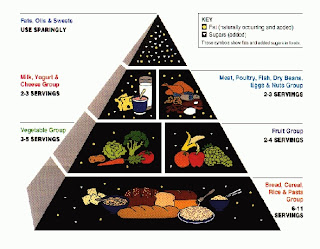
Its been a while since Ive talked about grains. Like over a year. Too long. Ive written Why You Dont Need Grains, about why you dont need grains. Duh. And Whole Grain Destruction, providing some hard science on the pitfalls of whole grains. Oh, and then there was Modern Wheat, explaining the difference between the wheat of the past and the wheat we eat today. Despite the nutritional shortcomings discussed in these articles though, most nutritionists still recommend a grain-based diet like the one depicted in this here food pyramid. Yes, its outdated, weve moved on to the Plate now. The philosophy is still the same.

As a nutrition professional, I think its important to talk to other nutrition professionals and understand their views on things, as they often differ from mine. Sometimes you learn something new from considering someone elses perspective.

I can remember one situation when I was doing my counseling internship at Student Health Services at UConn. I was shadowing a dietitian there, and a client that day mentioned that she didnt eat bread; she had heard we didnt need it in our diets to be healthy. Being the intern, I kept my mouth shut and let the counselor handle it. Of course, her advice was that we DO need bread, as it provides important vitamins and minerals. She may have had a point; ined flour products like white bread are enriched and fortified with B-vitamins (thiamin, riboflavin, and niacin), folic acid, and sometimes iron. For people who havent eaten vegetables or red meat in six months, maybe ined grain products actually serve a purpose.

So I started thinking... I wonder what it takes to get enough of these nutrients without grains?

B-Vitamins
This section will be short. If youre eating enough calories, its pretty difficult to be deficient in any of these vitamins. In fact, the only realistic way we would see a deficiency is if were getting most of our calories from ined grains that were not enriched; all of the ined grains in America are enriched. B-vitamins are found in meat, eggs, potatoes, sweet potatoes, veggies, fruits, nuts... pretty much all whole foods. I mean youd have to really be eating straight sugar or butter all day to not get enough of these. Theyre a non-issue. Next!

Folate
I say folate, not folic acid, because folate is the natural form found in food. Folic acid is the form added to foods (like grains) and used in supplements. This folate stuff is pretty darn important... its needed for several reactions involving DNA, which is the foundation for every cell in the body. Its also been found to be extra important in pregnancy; adequate folic acid levels can prevent the birth defect spina bifida.

Most of the food sources of folate are plant foods, with liver being the exception. Too bad liver is disgusting. I wish I could choke it down, I really do! Anyway, some of the best sources are greens and beans. Nice, that rhymed.

What does a full day of folate look like for a non-pregnant person? Glad you asked, here are a few examples:
  • 1/2 cup steamed spinach, 1/2 cup steamed collard greens, 1/2 cup kidney beans, 1/2 cup green peas
  • 1/2 cup lentils, 1 cup raw spinach, 1/2 cup asparagus, 1 small orange
  • 1/2 cup black beans, 1 cup steamed broccoli, 1 cup romaine lettuce, 1/2 cup Brussels sprouts
  • 6 oz. beef liver (Yuck.)
Some folate may be lost in cooking as well, depending on how long its cooked, so theres that to worry about too. 

You can get to the RDA for folate, sure. But is your average schmo doing this? No. Good thing those cheap grains are fortified with folic acid. And this doesnt even take into account a pregnant womans requirements, which are 50% higher. :-o 

Iron
This stuff.
First, its important to note that men and women have completely different iron requirements. According to the RDA, men only need 8 mg/day, while women need 18 mg/day. Premenopausal women, that is... losing all that blood every month has its consequences. After menopause, iron requirements for women drop back down to 8. Men should never have an issue getting enough iron. Women, on the other hand, have a little more trouble; girlies have a 6-10x increased risk of developing iron-deficiency anemia! (1)

The best sources of iron are animal foods. Clams, oysters, and liver are your most iron-rich foods. Red meat and poultry are second. And then weve got some random plant foods like pumpkin seeds, white beans, and lentils that sport nice iron profiles. Plant iron is less bioavailable than the animal type though, so the hard numbers are a little misleading.

The following are realistic ways to get 18 mg of iron in your day:
  • 2 cups kale, 1 cup steamed broccoli, 1 oz cashews, 1 cup edamame, 1/2 cup lentils, 1 medium baked potato, 4 oz boneless chicken breast, and 6 oz ground beef
  • 1/2 cup steamed spinach, 1/2 cup white beans, 1 oz pumpkin seeds, 1 1/2 cups roasted red potatoes, 5 oz chicken thighs, 3 oz shrimp
  • 1 cup roasted Brussels sprouts, 1/2 cup steamed Swiss chard, 1/2 cup prunes, 1/2 cup olives, 3 fried eggs, 1 oz canned clams, 6 oz sirloin steak
  • 10 oz beef liver (Okay, not realistic. Yuck.)
Thats kind of a lot of food, no?? You women have a tough life! Sure, a determined, health conscious woman would have no problem with this kind of intake, but your average American? Hell naw. Probably a good thing those junk breakfast cereals are fortified with iron.


Okay. Obviously we dont need grains in our diet. Theres nothing special in grains that we cant get elsewhere. But for the average person who doesnt give a crap about his or her diet, eats Hot Pockets and McDonalds all the time, and hasnt touched spinach since the 90s... theyre pretty important. Folic acid and iron are vital, especially for certain populations... pregnant women in the case of folate, young women in general in the case of iron.

If its nutrient density and optimal health youre after, theres no reason for you to eat grains in any significant amount. But most people arent you. If youre an average American, I say you need them. Call me crazy. 

Monday, December 9, 2013

Why Teeth Whitening Systems Are So Effective

Tobacco, coffee, tea or age are the main reasons for the teeth problems, but there are case where some antibiotics as well such as tetracycline or too much fluoride can cause them.
If you are in this condition you can visit as well as consult your dentist, and let him know about your problems in order to suggest you a number of whitening systems. There a lot of Teeth whitening systems such as: Bleaching kits, Bonding, Porcelain veneers, Whitening Toothpastes used by dentists, which can be purchased at any time. All the ingredients included in the tooth whitening systems can be used carefully at home.
Our Teeth whitening system can do a lot for you, having in mind that customers must put on thin thermoforming trays over the top and bottom teeth for only 15 -30 minutes a day - and this is a single Session. This system does not include any fluoride and its quality formula actually reduces tooth sensitivity with no question asked at all. Guarantee your total satisfaction with the results of our product or your money back - this is with every product in this niche, because the smile of your face if one of the thongs that people will see and comment as well.
Using such a teeth whitening system you should stick to the instructions given on the site or those, which are shipped with the product. In both cases you will have maximum results if you do it correctly. Some dental products have strict rules of using them in order to achieve what you are looking for, while others are just well-know on the market and have no specific rules, just a short instruction and thats all. The second ones are used in a family as a normal product.
As you know some people go to dentist not only to fix their teeth, but to make them more attractive, white and beautiful. Well if you need to go to dentist and make them more attractive as well as white you have to think of a product that can bring them in this condition without all the procedures, something that is provided on the offline or online stores. Teeth whitening system are available online and offline, thats why laser procedures are replaced by these easy to use and safe supplements.
The White Light teeth whitening system is a teeth whitening procedure you can do at home. The best thing about it is that White Light offers all the advantages of a laser teeth whitening procedure, while being quick, and easy to use.

Saturday, November 2, 2013

Why Baby Crying Without Tear

Why Baby Crying Without Tear - Crying is the baby way for communication with other, when cry baby with his red face communicate but without out the tear, why baby crying does not shed tear?

The team of author of American Academy of Pediatric "Heading Home With Your Newborn", Jennifer Shu said: When baby born, the baby tear gland just produce a little of tear, its to protect the eye. So, this is have not the tear that out when baby on crying.
baby tear
The tear is produced when baby have a month and three month of age. a long the development of age, the will more increase. said shu.

In the meantime, if your baby tear out even though he was not crying, his tears could be a channel clogged. "Usually these disorders would normally own, but if the cornea of ​​the eye baby looks red, or swollen, there may be an infection. Immediately contact your doctor," she advised.